Daijiworld Media Network - Chandigarh
Chandigarh, Sep 17: The government will provide Rs 2.9 crore to 2,550 farmers in Punjab and Haryana who adopted regenerative farming practices and earned carbon credits for the first time.
Dr M L Jat, Secretary of the Department of Agricultural Research and Education (DARE) and Director General of the Indian Council of Agricultural Research (ICAR), initiated the Direct Benefit Transfer (DBT) to the selected farmers.
“The carbon payments provide an economic incentive for practices that also generate environmental benefits,” Jat said.
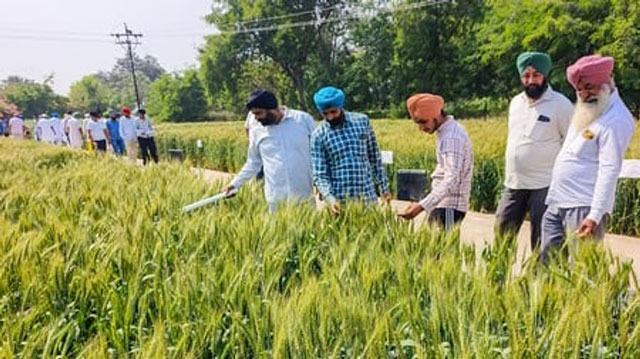
The farmers adopted practices including Direct Seeded Rice (DSR), reduced tillage and crop residue management between 2019 and 2022. These practices helped reduce greenhouse gas emissions and increase soil carbon. Their eligibility for carbon credits was independently verified before the credits were issued.
The payments are part of “Aadi”, a farmer carbon programme launched by Grow Indigo in 2019 with technical guidance from ICAR. The programme covers more than two million acres and involves over 100,000 farmers across seven states. It issues agricultural carbon credits under the Verra VM0042 methodology.
Jat said DSR reduces irrigation requirements compared with conventional rice transplanting, while improved crop residue management can help reduce stubble burning and associated air pollution.
For enrolled fields between 2019 and 2022, the programme estimates that the practices saved 45 billion litres of water and prevented more than 200,000 tonnes of crop residue from being burned. This is estimated to have avoided around 1,000 tonnes of PM2.5 emissions.
The programme supports the wider transition towards regenerative agriculture in Punjab and Haryana, with a focus on crop residue management, water conservation and farming systems aimed at improving soil health and climate resilience.
ICAR institutions have provided scientific and field expertise in areas including greenhouse gas accounting, crop simulation modelling, soil sampling protocols, device validation, field team training, and satellite and remote sensing techniques.
Union Agriculture and Farmers’ Welfare Minister Shivraj Singh Chouhan has, during his visits to Punjab under the Viksit Krishi Sankalp Abhiyan and other interactions with farmers and agricultural institutions, stressed the importance of farmer-focused agricultural research and adoption of sustainable technologies. He has also highlighted direct-seeded rice and crop residue management practices.
During his visit to Punjab in June 2025, Chouhan interacted with farmers and reviewed farming practices as part of the campaign.