Daijiworld Media Network - Kathmandu
Kathmandu, Sep 6: The death toll from the devastating flash floods that swept across northern and central Nepal has climbed to 1,344, while around 4,900 people remain missing as rescue teams intensify operations at several hydropower projects and other disaster-hit locations.
The floods, triggered by an ice-rock avalanche near the Nepal-Tibet border on Aug 26, sent a massive torrent of water, mud, rocks and debris down the Bhotekoshi River. The disaster devastated settlements, swept away homes, vehicles, roads and bridges and severely damaged several hydropower projects.
Of the 1,344 bodies recovered in Nepal, 758 were adults and 85 were children, while 501 were recovered in an unidentifiable condition or with body parts missing because of prolonged exposure to water and heavy debris. Chitwan district has recorded the highest number of recovered bodies, with around 360, while bodies have also been recovered from Rasuwa, Nuwakot, Dhading, Gorkha, Tanahun and Nawalparasi districts. More than 1,000 bodies have been temporarily buried after forensic procedures, including DNA collection, were completed.
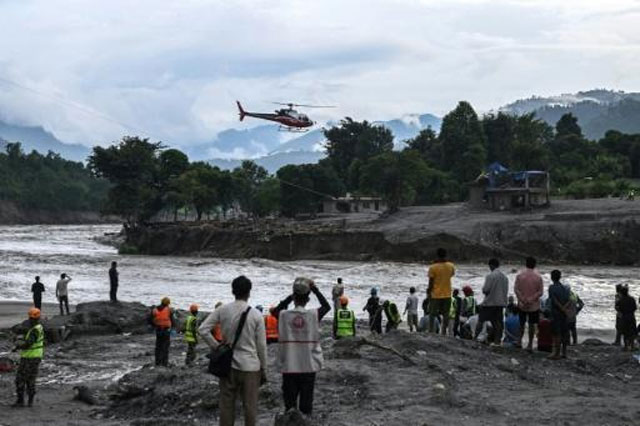
More than 13,000 people have so far been rescued. Authorities say the disaster has affected more than 32,000 people and caused extensive damage to roads, bridges, schools, healthcare facilities and hydropower infrastructure. Search teams continue to monitor water levels in several major rivers as rescue operations enter their second week.
The latest rescue operations have brought renewed hope after two people were found alive on Saturday, nearly 10 days after the disaster. Chinese hydropower worker Lu Haitao was rescued from about 225 metres inside a flooded tunnel at a hydropower project in Rasuwa district. A joint team of Nepal Army personnel and South Korean disaster specialists brought him out. He was flown by helicopter to Kathmandu for medical treatment and was reported to be in stable condition, although he was suffering from mild hypothermia.
In a separate operation in neighbouring Nuwakot district, 64-year-old Chandika Kumari Shrestha was rescued alive from her mud-covered, flood-damaged home. Rescuers provided her water before taking her to safety, and she was subsequently airlifted to Kathmandu for treatment. Both survivors had been trapped since the Aug 26 disaster.
The two rescues came a day after two Nepali hydropower workers, identified as 45-year-old mechanical supervisor Kabir Maharjan and 30-year-old foreman Sanjay Sah, were rescued alive from a tunnel at the Trishuli 3A hydropower project. Their rescue had raised hopes that other workers could still be alive inside the extensive tunnel network damaged by the floods.
Around 900 workers are still unaccounted for at 12 hydropower projects across Nepal, with roughly 500 believed to be trapped inside tunnels. Rescue teams are therefore concentrating heavily on hydropower sites where workers may have survived in pockets that remained protected from the floodwaters.
India has stepped up its specialised tunnel-rescue assistance. The Indian team working alongside the Nepal Army at the Chilime hydropower project in Rasuwa has dug deeper into the tunnel to drain water that was obstructing operations. A temporary track has also been created inside the tunnel to enable the movement of heavy rescue equipment. The Indian team has also been conducting medical assistance for local communities in the affected area.
Indian tunnel-rescue specialists are also working with Nepali teams at Langtang. At the site, Nepal Army personnel and hydropower workers have opened another small hole on the upstream side of the tunnel using drilling equipment, with further work continuing.
Chinese tunnel-rescue specialists remain deployed at the Upper Trishuli 3A site, working alongside Nepali rescuers with additional personnel and equipment. At Upper Trishuli 3B, Nepal Army personnel and hydropower technicians are using excavators, while a specialised Collapsed Structure Search and Rescue team has also joined the operation. Nepali Army and hydropower personnel have re-entered the Upper Trishuli tunnel at Haku to continue searches.
At the Upper Trishuli 1 project, South Korean tunnel-rescue specialists are working with Nepali teams to gain access to the tunnel. The international effort also includes forensic and disaster victim identification specialists. A 19-member Indian forensic team, a five-member specialised Chinese forensic team and members of Singapore's Disaster Victim Identification team are assisting Nepali authorities with DNA collection, analysis and identification of recovered bodies. South Korean forensic officials have also joined the operation.
More than 9,300 Nepal Army personnel have been deployed across the affected areas, stretching from Timure in Rasuwa to Nuwakot, Dhading, Chitwan and Nawalparasi East. Their duties include search and rescue, recovery and management of bodies, clearing roads and providing emergency medical assistance.
Nepal has received specialised assistance from India, China, South Korea and other international partners, with rescue equipment, drones, load carriers and other materials being deployed in the affected areas. Authorities have also sought additional high-capacity drones, LiDAR equipment, Bailey bridges, ground-penetrating radar, laser measurement equipment, DNA testing kits, human-remains bags, pumps and other specialised equipment to strengthen the operation.
The disaster has also affected neighbouring Tibet, where the same flood event caused significant loss of life and left hundreds missing. The catastrophe has highlighted the vulnerability of Himalayan communities to sudden glacial and ice-rock events and the increasing risks posed to settlements and hydropower infrastructure in the region.
Despite the rising death toll and difficult weather and terrain, the discovery of survivors more than a week after the disaster has encouraged rescuers to continue searching tunnels and debris-covered structures. Authorities say locating those still missing remains the priority, with international rescue teams working alongside the Nepal Army in what has become one of the country's largest disaster-response operations in recent years.