Daijiworld Media Network – Bishkek
Bishkek, Sep 1: Prime Minister Narendra Modi and Russian President Vladimir Putin held talks in Kyrgyzstan’s Bishkek on Monday on the sidelines of the Shanghai Cooperation Organisation (SCO) summit, with the meeting coming amid major geopolitical developments and growing concerns over global energy security.
The two leaders met at the Aksakal Meeting Room at the Bishkek Ala Archa State Residence. Putin was accompanied by a delegation of senior Russian officials, including ministers. Modi and Putin exchanged a warm hug before entering into discussions.
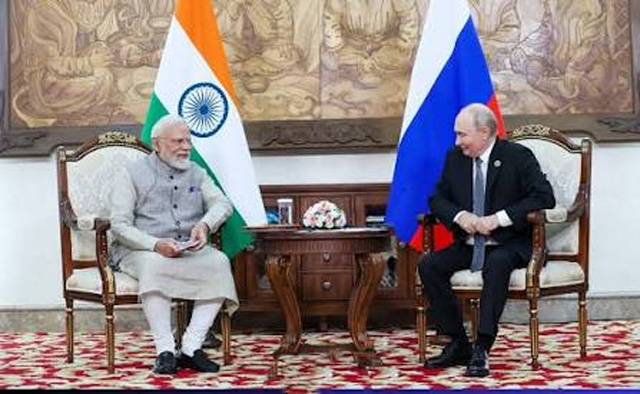
Putin said at the beginning of the talks that ties between Moscow and New Delhi were continuing to grow stronger.
During the interaction, Modi reiterated India’s position on the Russia-Ukraine conflict and called for an end to hostilities.
“Every day spent in war sets humanity back, whereas every step taken towards peace fills humanity with new hope and enthusiasm,” Modi said, stressing that India supports all efforts towards peace.
He said the world must move away from endless wars towards a peaceful resolution of conflicts, adding that the “land of Gandhi and the land of Buddha” share the message of peace.
The meeting also assumes significance amid heightened tensions in the Middle East and concerns over global energy security. India has increasingly relied on Russian crude to meet its energy requirements, while Russia remains keen to sustain its oil exports amid geopolitical and economic pressures.
During the meeting, Modi invited Putin to attend the upcoming BRICS Summit in New Delhi in September. Modi said Putin’s visit would further strengthen India-Russia relations.
Putin thanked Modi for his personal attention to the Russia-India relationship and acknowledged his role in maintaining the momentum of bilateral ties.
Modi arrived in Bishkek on Sunday to participate in the 26th SCO Summit after concluding his state visit to Uzbekistan. The summit brings together leaders of SCO member states to discuss regional and international issues and strengthen cooperation within the grouping.