Daijiworld Media Network - Guwahati
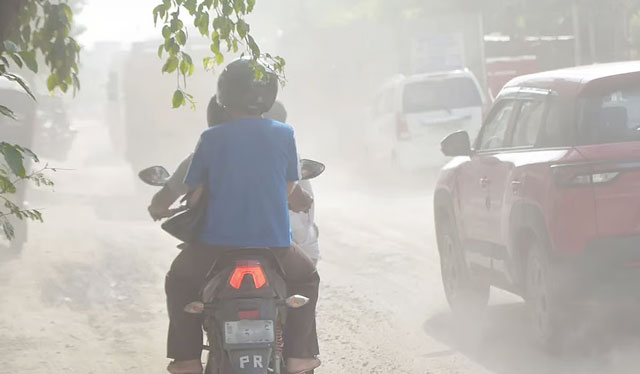
Guwahati, Feb 24: A sharp rise in dust pollution levels across Assam — reportedly exceeding benchmarks set by the World Health Organization — has led to a surge in respiratory and allergy-related ailments, with Guwahati emerging as the worst-affected city.
Residents across the state are reporting symptoms such as runny nose, nasal congestion, post-nasal drip, coughing, sneezing, skin rashes and breathing difficulties. Medical practitioners attribute the spike in such cases primarily to heightened dust levels aggravated by scanty rainfall and extensive construction activities.
Climate variations have further compounded the problem. Traditionally, temperatures in Assam hover between 25 and 27 degrees Celsius in February. This year, however, temperatures have risen to 30–31 degrees Celsius. The state has reportedly not witnessed significant rainfall in the past three to four months, resulting in a persistently dusty atmosphere.
A Guwahati-based doctor said patients from all age groups are seeking treatment for dust-related allergies and respiratory distress.
“Dust allergy is one of the prime reasons behind such problems. People must be aware and make wearing masks a regular habit while stepping out. The situation can turn serious when microscopic particles enter the lungs, travel through the bloodstream, and cause damage to the respiratory, cardiovascular and nervous systems,” the doctor cautioned.
The situation is particularly alarming in Guwahati, where large-scale infrastructure projects — including flyovers, high-rise buildings and structural repairs — are underway. Residents allege that inadequate dust-control measures have resulted in thick layers of dust settling on roads, footpaths and even treetops.
Areas surrounding ongoing flyover construction works are reportedly witnessing the highest levels of airborne dust. Civic authorities and construction agencies have been urged to undertake regular water spraying to settle dust particles, but residents claim such measures are rarely visible.
In a recent incident highlighting the severity of the problem, an IndiGo flight bound for Dibrugarh from Guwahati was diverted to Imphal due to reduced visibility attributed to dust.
Compounding the issue, earth-laden dumpers transporting soil from nearby hills are allegedly spilling portions of their loads onto city roads. In several localities, construction companies have left excavated soil uncovered along drains and roadside stretches, which turns into fine dust under constant vehicular movement.
Health experts have warned that unless immediate and sustained measures are implemented to curb dust pollution, Assam could face a worsening public health crisis in the coming months.
Residents and environmental observers have called upon district administrations, civic bodies and infrastructure developers to urgently adopt dust-control protocols and enforce stricter compliance to safeguard public health.