Daijiworld Media Network - New Delhi
New Delhi, Dec 15: Lakshadweep has emerged as a major investment hotspot in India’s Blue Economy, with proposals worth over Rs 500 crore generated during its first-ever investors’ meet, according to an official statement released on Sunday.
The proposed investments span high-potential sectors such as tuna and deep-sea fisheries, seaweed cultivation, ornamental fisheries and waste management. To support and fast-track these projects, authorities are developing a single-window clearance system aimed at simplifying approvals and easing the investment process in the island territory.
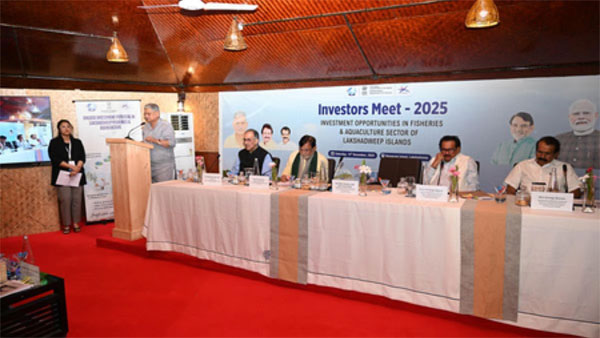
The two-day investors’ meet, held over the weekend in the Bangaram Islands, brought together 22 investors and leading entrepreneurs from across the country. Organised by the Union Department of Fisheries, the event was attended by Union Minister for Fisheries, Animal Husbandry and Dairying Rajiv Ranjan Singh, along with Minister of State George Kurian.
During the meet, the Department of Fisheries showcased a wide range of opportunities in tuna fishing, offshore seaweed farming, hatcheries, brood banks, integrated fisheries units and offshore cage farming, highlighting Lakshadweep’s vast untapped marine resources.
Officials underlined Lakshadweep’s strategic importance in tuna and deep-sea fisheries, noting that the islands account for nearly 20 per cent of India’s Exclusive Economic Zone. While the region’s waters support rich stocks of tuna and other high-value species, current production stands at only about 15,000 tonnes—far below the estimated potential of nearly one lakh tonnes. By building a modern value chain encompassing sustainable fishing practices, certification, branding and export-focused processing, Lakshadweep tuna could be positioned as a premium global product under labels such as “Lakshadweep Sustainable Tuna.”
The statement also pointed out that traditional fishing methods followed in the region align well with global eco-certification standards such as the Marine Stewardship Council (MSC), opening doors to premium international markets. Investment opportunities further extend to smart fishing harbours, cold-chain infrastructure, processing units, and fleet modernisation using advanced deep-sea vessels with onboard storage and processing facilities, as well as mother vessels for aggregation and transport.
Seaweed cultivation emerged as another key focus area. With over 4,200 square kilometres of lagoon area, Lakshadweep offers ideal conditions for large-scale seaweed farming. Rising global demand for seaweed-based products has created strong prospects in nurseries, biomass processing and bioproduct manufacturing. As a notified Seaweed Cluster under the Pradhan Mantri Matsya Sampada Yojana (PMMSY), Lakshadweep has already established foundational infrastructure such as a seaweed seed bank and hatchery.
The Lakshadweep administration is also finalising a leasing policy to enable private-sector participation in offshore seaweed farming. Beyond economic returns, officials noted that seaweed cultivation delivers environmental benefits, including carbon sequestration and enhanced marine biodiversity, while supporting industries such as food, pharmaceuticals and cosmetics.
The islands’ rich marine biodiversity—home to nearly 300 species of ornamental fish across 35 families—was highlighted as a major opportunity for the aquarium trade. Establishing ornamental fish hatcheries, broodstock facilities and integrated rearing units could reduce dependence on wild catch while tapping into growing global demand.
Additionally, Lakshadweep’s vast Exclusive Economic Zone of nearly four lakh square kilometres offers strong potential for offshore cage farming and large-scale mariculture. Successful pilot projects in other coastal states have already demonstrated the viability of this model.
Collectively, officials said, these initiatives position Lakshadweep as a future hub for sustainable fisheries, marine innovation and export-driven growth within India’s expanding Blue Economy.